
The homes you are staging
Historic Old Northeast is the North Shore Historic District in the National Register. Its 2003 registration form counts 3,489 buildings in about 425 acres, most of them one- and two-story homes built between about 1910 and 1950. Frame Vernacular and Bungalow are the most common styles, at about a quarter of the buildings each, followed by Georgian, Prairie and Mediterranean Revival.
For staging, that means rooms that are often smaller and more separate than in a newer home, with original trim around every opening, wood floors, and features such as fireplaces and built-ins that buyers come to see. The aim is to help a buyer read those rooms, not to modernize them.
Which rooms to stage
Stage the rooms buyers see first and the ones hardest to read empty, then stop. In most Old Northeast homes that is the front or living room, the dining room and the primary bedroom. Bathrooms, hallways and kitchens with fixed cabinetry rarely need staging. A listing can mix staged and unstaged photos, as long as each staged one is disclosed.
Separate rooms and openings
Many older plans divide the main floor into a front room, a living room and a dining room joined by wide cased openings. Give each room one clear purpose: a seating group facing the fireplace or the front windows, and a dining table centered under the ceiling light. Keep the openings clear so a buyer can see how one room leads to the next, and keep furniture off door swings a buyer will meet at the showing.
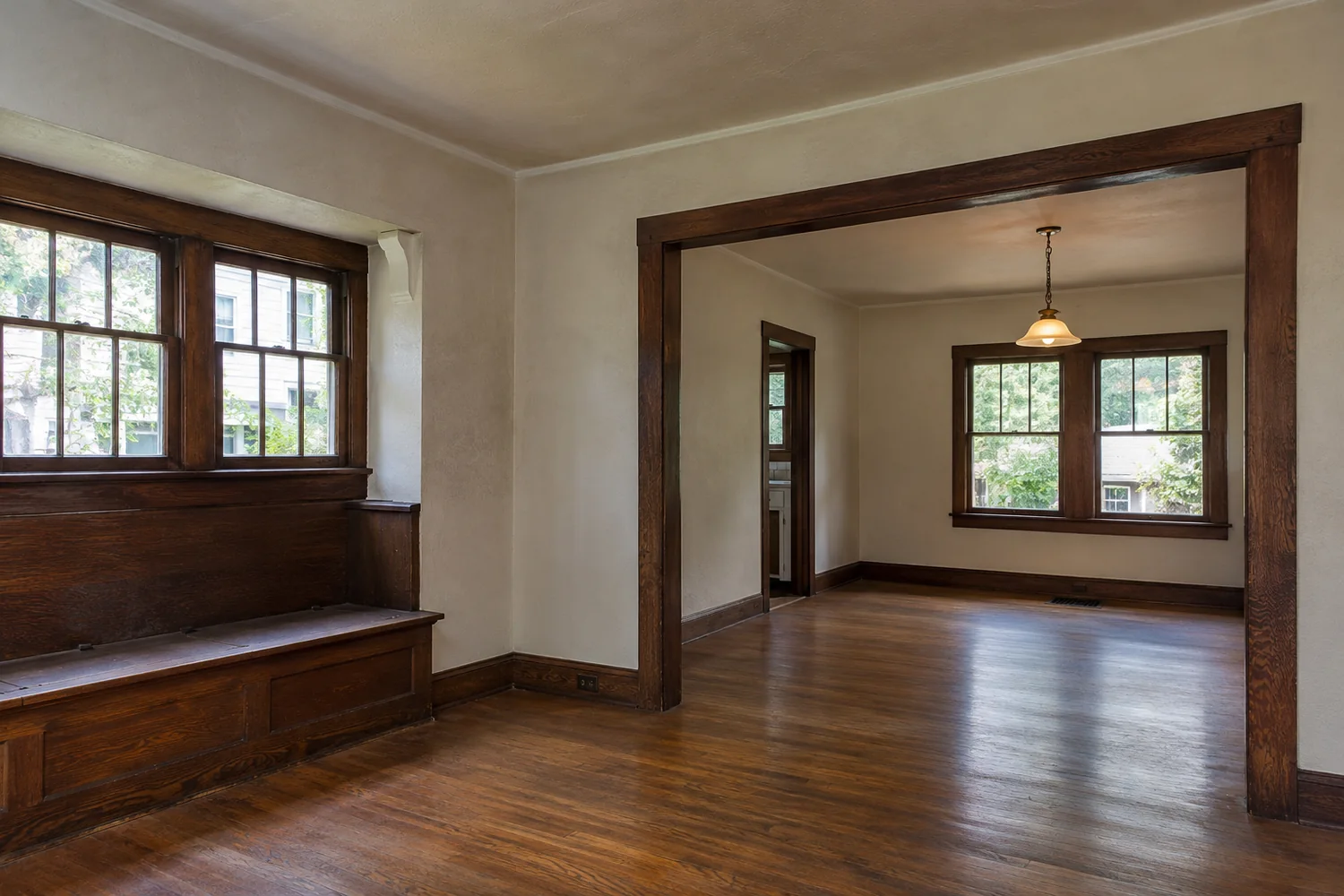
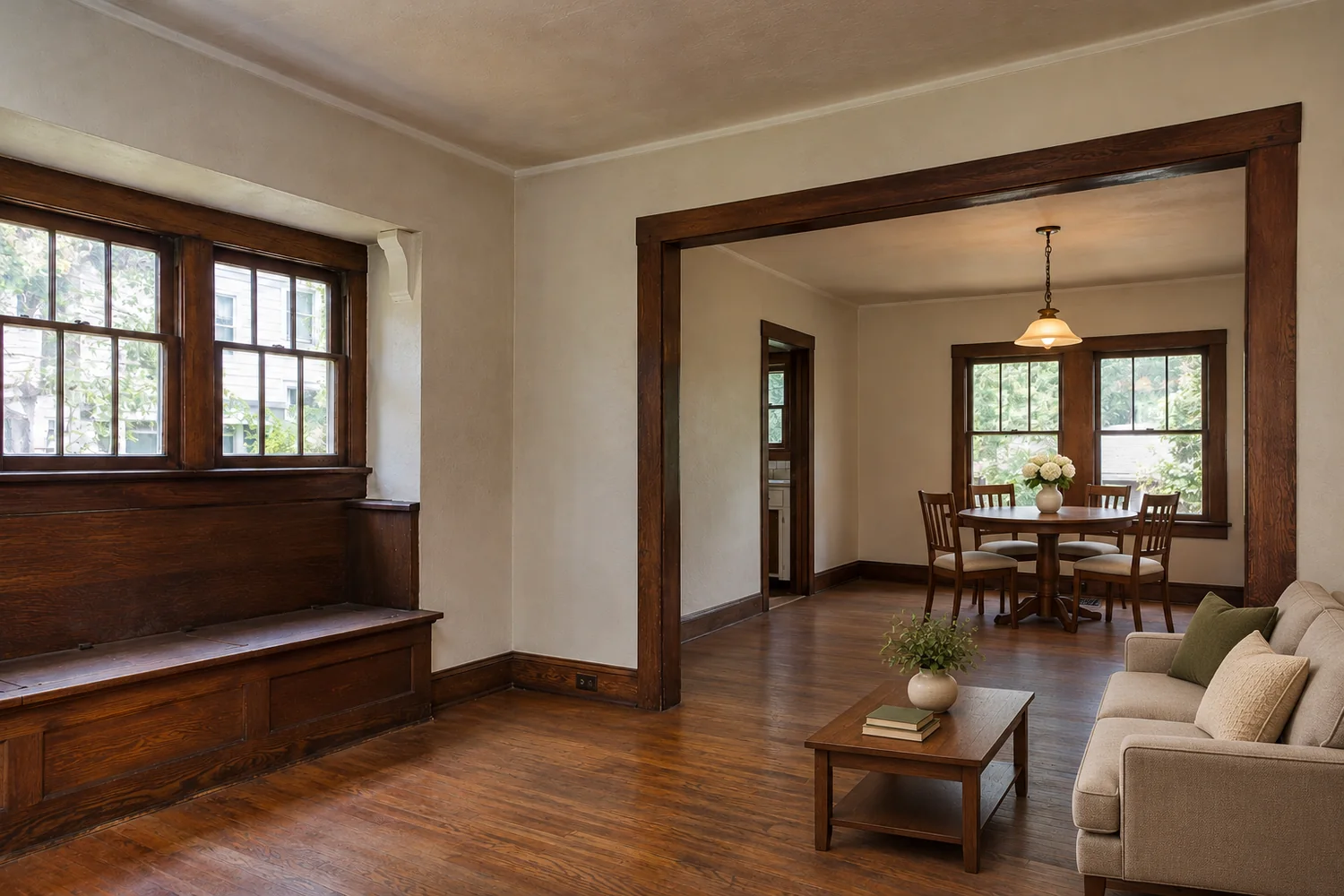 Before After
AI-generated virtual staging demonstration. About these images
Small bedrooms and true scale
Bungalow and cottage bedrooms are often small. Stellar prohibits distorting a room's dimensions, and gives undersized furniture as its example, so a bedroom is staged with a bed that genuinely fits, plus room to walk around it. Use the door as a ruler: a standard interior door is about 6 feet 8 inches tall, so the bed should look right beside it. If a full-size bed will not fit believably, a smaller room can be shown as an office or a nursery when that is a fair use of the space.
Working around original features
Fireplaces, mantels, built-in bookcases, window seats, china cabinets, original light fixtures and ceiling fans are part of the house. They are never removed, covered or redrawn. Seating can face a fireplace without blocking it, and a rug can sit on a wood floor without hiding its condition. The floor, trim and walls stay as photographed, including any wear.
Porches and sunrooms
A front porch photo is an exterior photo. Stellar allows exterior photos to show added unattached furniture or decor only, so a pair of chairs or a swing that stands on its own can be added, while columns, railings, floor boards and steps stay as they are. An enclosed sunroom is an interior room and can be staged like any other, with the windows and the view through them unchanged.
Garage apartments and second units
The registration form counts 1,305 historic garages and garage apartments among the district's contributing buildings. When a home comes with a second unit, stage its rooms at their real size, and make sure the listing makes clear which photos show the second unit and which show the main house.
Choosing a style
Choose a direction that suits the house and its likely buyers. Simple, well-scaled pieces in warm materials tend to sit naturally against original trim and wood floors, but there is no rule that an older house must be staged in period furniture. Furniture is chosen for style and scale rather than as a historical reconstruction. Whatever the style, it stays in the furniture and decor; the house is not changed to match it.
The Stellar rules that matter here
- Virtually staged photos are disclosed in the listing fields: "Virtually staged" in the photo description, the virtually staged field checked, and public remarks beginning "One or more photo(s) was virtually staged." Words and branding on the photo itself are not allowed.
- Permanent fixtures cannot be changed, and negative elements such as holes in a wall, exposed wiring or damaged flooring cannot be removed.
- Paint colors cannot be changed and landscape plantings cannot be added in listing photos.
- Views and lighting that could not exist cannot be added.
- Virtual staging cannot be used for pre-construction or under-construction properties, which matters for a home in the middle of a renovation.
Summarized from Stellar MLS Article 04.04 and the Stellar photo rules page, as read on stageliora.com on November 5, 2026. The listing and its disclosure stay the listing agent's responsibility.
Checklist before you list
- Each staged photo checked against its original: walls, trim, windows, floors and fixtures match
- Fireplaces, built-ins and openings still visible
- Furniture looks right beside the doors
- Porch photos show only added unattached furniture or decor
- Second-unit photos identified as such
- Disclosure completed in the Stellar listing fields; originals kept
Questions
Can a home under renovation be staged?
Not for Stellar listing photos while it is under construction. Article 04.04 says virtual staging shall not be used for pre-construction and under-construction properties. Once the work is finished, the rooms can be photographed and staged.
Should every room be staged?
Usually not. Stage the rooms buyers see first and the ones hardest to read without furniture, then stop.
Sources
- National Register of Historic Places registration form, North Shore Historic District (Florida Bureau of Historic Preservation, January 2003) — read November 18, 2026
- National Park Service, NRIS record 03000040 (North Shore Historic District) — read November 18, 2026
- Stellar MLS, Article 04.04 and the Stellar photo rules page (as summarized on stageliora.com) — read November 5, 2026